Have you ever felt that yearning, deep in your bones, for something higher, something holier, something more? That sacred hunger is not just spiritual curiosity. In Mormon Kabbalah, it’s the soul remembering its journey home. And the name of that journey is Aliyah, the holy ascent. But don’t worry, you don’t need hiking boots or airline miles. This ascent is inner. It’s eternal. And it’s available to everyone.
Ascent Through the Sefirot
In Hebrew, Aliyah means “to go up.” Traditionally, it referred to pilgrimage, to ascending to Jerusalem or being called up to read the Torah. But in Mormon Kabbalah, Aliyah is much more than a physical elevation. It’s the spiritual rising of the soul toward its divine source, the Creator. 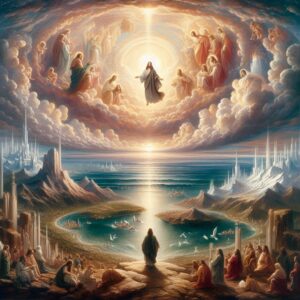 The Tree of Life in Kabbalah consists of ten main or twelve total Sefirot, representing stages of divine energy or consciousness. In Mormon Kabbalah, God takes us to the top of the tree, Keter, and we work our way down. However, this is just one way to understand the 32 paths. In truth, we move all over the tree, top to bottom and bottom to top. Aliyah involves moving from one Sefirot to another, tying the heavens to the earth. This can be seen as connecting Sefirot tied to physical and emotional experiences, like Malchut and Yesod (the days of creation) to the divine attributes, Keter, Da’at, and Chokhmah.
This ascent mirrors a journey from the material world to the spiritual and ultimately to the Infinite Sefirot, Ein Sof (the full Tree of Life). Ascending from Malchut (kingdom, the earthly realm) to Tif’eret (beauty, the balance of mercy and judgment) symbolizes moving from worldly concerns to a balanced spiritual state. It’s the path of progression, step by step, world by world, drawing nearer to God by degrees of holiness and consciousness. In the Book of Mormon and other Restoration scriptures, this ascent is echoed in phrases like “rising up to God,” “putting off the natural man,” and “being Saints.” Aliyah is the process by which you become more divine, more aligned with your true self, your heavenly origin.
Aliyah and the Four Worlds
In Mormon Kabbalah, the universe is made of Four Worlds, levels of spiritual reality:
- Asiyah (Action): The physical world. The beginning of our journey.
- Yetzirah (Formation): The emotional and imaginative world. Where we shape identity.
- Beriah (Creation): The intellectual and spiritual world. The place of inspired knowing.
- Atzilut (Emanation): Pure unity with God. The world of Divine Oneness.
Aliyah is often described as the soul’s journey back to its divine source, your soul’s ascent through these worlds, learning and purifying in each, until returning to the source from which we came. In life, the spirit experiences yeridah (descent) into the physical body and the material world, which is seen as an opportunity for spiritual growth, the birth of the soul, and repair (Tikkun). Through Aliyah, the soul transcends these worldly limitations, seeking reunion with the Divine. We see this in the story of Jacob’s ladder (Genesis 28:12/1 Moses 39). Jacob’s dream is a classic Kabbalistic metaphor for Aliyah, with angels ascending and descending, symbolizing spiritual journeys between realms. Think of it like climbing Jacob’s ladder, but you’re not just climbing into heaven, you’re becoming heavenly.
How to Practice Aliyah
Aliyah isn’t about mystical jargon or lofty rituals. It’s about becoming more awake, more loving, and more you, the divine you. Here’s how to start:
- Listen to the Holy Spirit. In Mormon Kabbalah, mitzvoth are anything the Holy Spirit inspires you to do. Every spiritual nudge is a step up Jacob’s ladder.
- Use meditation and prayer. This includes scripture study, specially the kind that brings you inward, and Mormon Kabbalistic ritual meditations. When you go deep enough inside yourself, you begin to rise toward heaven.
- Embrace struggle. Every spiritual ascent is preceded by a descent. Don’t run from the wilderness, let it shape you for Zion.
- Balance the inner and the outer. Aliyah is not about escaping earth. It’s about elevating it. Bring heaven into your words, your work, your relationships.
Mystical Aliyah During Prayer
Prayer, to the Mormon Kabbalist, is a meditation. We use it to ascend, Aliyah, to God as we deepen our personal relationship with the divine. We first listen to the Holy Spirit to know what to pray on, then we speak to God, then we listen for God’s answers. Prayer is the most common method for ascending through the spiritual realms. Focused meditative techniques will help guide you through higher levels of consciousness. This can be prayer or scripture study. It can also be the prayer in our hearts, how we walk in our lives. Aligning actions with divine will helps elevate the soul.
These acts of kindness are the manifestation of our prayers and Scripture studies. Our walk, how we live our lives, shows that we are on “the Way” (the Torah’s path) performing our mitzvoth. This is more than mere actions. Maintaining mindfulness of God’s presence throughout daily life facilitates spiritual ascent. In other words, it is why we do what we do as much, if not more than, why we do it. As James said, “I will show you my faith by my good deeds” (James 2:18).
Aliyah Through Torah Study
 Engaging deeply with Torah and its mystical interpretations is a key form of Aliyah. Each level of understanding—Peshat (simple), Remez (hint), Derash (inquiry), and Sod (secret)—represents an ascent into greater divine wisdom. The study of the Book of Mormon and the Plates of Brass, Mormon Kabbalah’s foundational texts, is itself considered a form of Aliyah, as it illuminates hidden truths of creation and God’s will. We can only understand the scriptures through the Voice (the Holy Spirit). Reading the Scriptures with God helps us ascend to the upper worlds to deepen our understanding of God will.
Aliyah and the Sabbath
The Sabbath (Shabbat) is seen as a time when the soul naturally experiences Aliyah. It is described as a taste of the world to come (Olam HaBa), when spiritual energies are heightened, and the soul can ascend to a higher plane. The special prayers, songs, and observances of Shabbat guide participants in this mystical ascent. For the Mormon Kabbalist, the Sabbath is more than one day, it can be observed daily as we take time out of our normal lives to spend time with God. As Jesus taught, “The Sabbath was made for man, not man for the Sabbath” (Mark 2:27).
Jesus and the Great Aliyah
In Mormon Kabbalah, Jesus (Yeshuah) is the ultimate guide on the path of Aliyah. His condescension, leaving divine glory to enter our fallen world, was a descent for the purpose of ascent. That’s a key pattern in Kabbalah called Yeridah L’Tzorech Aliyah, “descent for the sake of ascent.” Christ descends into the wilderness of our suffering, lifts us up, and invites us to follow Him, not just to believe in Him, but to become like Him (). Every act of love, every inspired mitzvah (commandment from the Holy Spirit), every time we choose light over shadow—we rise. And Jesus is the hand that pulls us upward.
The Significance of Aliyah
Aliyah isn’t about escaping this world. It’s about transforming it by ascending through it. Each step you take upward becomes a light to someone else on the path. In Mormon Kabbalah, we say:
“To ascend is to awaken. To awaken is to return. And to return is to become one with God.”
So when your soul stirs with longing, when the veil feels thin, when you glimpse something holy behind your everyday life, that’s Aliyah whispering: “Come up higher.” You don’t have to climb a mountain tp get closer to God, you are the mountain. You don’t have to wait for a call to Zion, every breath is a calling. Every loving act is an ascension. So light your soul, open your hear, and climb inward. This is Aliyah.
“I was caught up to the third heaven fourteen years ago. Whether I was in my body or out of my body, I don’t know—only God knows.” -2 Corinthians 12:2, New Living Translation